Cryoneurolysis / Cryoanalgesia
How does this procedure work?
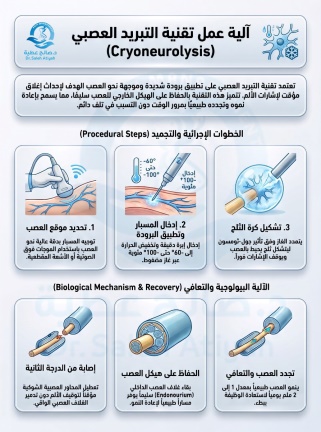
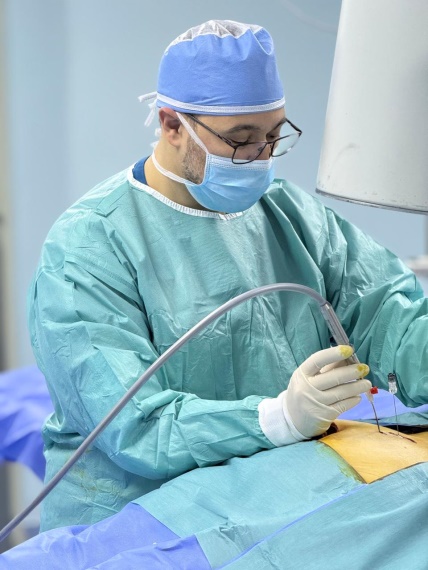
Cryoneurolysis is a minimally invasive medical procedure (it does not require open surgery) used to temporarily interrupt the transmission of pain signals through specific nerves using extreme cold. Its mechanism can be summarized in the following steps:
Precise identification of the nerve
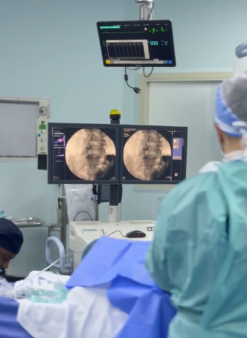
The interventional pain physician uses advanced imaging equipment such as ultrasound or X-ray/computed tomography (CT/Fluoroscopy) to clearly visualize and identify the precise nerve causing pain.
Application of controlled cold
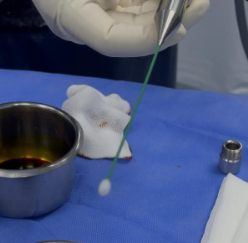
A fine probe (Cryoprobe) is inserted near the nerve, delivering extreme cold (ranging from -20 to -100 degrees Celsius using nitrous oxide or carbon dioxide gas) to form a small “ice ball” that surrounds and freezes the target nerve.
Interruption of pain signals (temporary effect)
The cold disrupts the ability of the nerve’s internal fibers (the axon) to send pain signals to the brain, while fully preserving the nerve’s protective outer sheaths.
Natural nerve regeneration and recovery
Because the nerve’s protective outer sheath remains intact, the nerve begins to grow and recover spontaneously at a slow rate of 1 to 2 mm per day. This ensures the later restoration of sensation and normal function without the risk of painful neuroma formation.
Duration of relief and analgesia
Pain relief usually lasts from 3 to 12 months (and may last longer depending on the nerve and the patient’s condition). The procedure can be safely repeated when the nerve regrows, if needed.
Its various uses in interventional pain management
Cryoneurolysis is a versatile option for managing various pain conditions, including:
Chronic joint and bone pain
- Knee osteoarthritis: Targeting the genicular nerves to relieve pain and improve walking and mobility.
- Chronic shoulder pain: Targeting the suprascapular and axillary nerves.
- Spinal and joint pain: Treating facet joint pain, sacroiliac joint (SIJ) pain, and lower back pain.
Neuropathic pain and peripheral syndromes
- Occipital neuralgia causing headaches, and trigeminal nerve pain.
- Chest wall and rib pain (intercostal neuralgia) resulting from rib fractures or chest surgery.
- Nerve pain in the groin and pelvis, involving nerves such as the pudendal nerve and the ilioinguinal nerve.
- Phantom limb pain and neuromas: Managing pain after amputation and painful neuromas.
Management of spasticity
- Reducing stiffness and involuntary muscle spasms in the limbs resulting from nervous system injuries (such as stroke, multiple sclerosis [MS], and cerebral palsy) without causing permanent damage.
Post-surgical pain and cancer pain
- Relieving acute and chronic pain after mastectomy, chest surgery, or joint surgery.
- Relieving intractable cancer pain (such as pancreatic cancer pain by targeting the celiac/visceral plexus).
Features and benefits for patients
Cryoneurolysis offers several benefits that make it a preferred option in interventional pain clinics:
Minimally invasive and painless procedure
Performed under local anesthesia in the clinic within a short period (approximately 30 minutes), without the need for open surgery or general anesthesia.
Immediate and extended pain relief
Provides immediate or rapid pain relief lasting for many months, allowing an easier return to daily activities and physical therapy.
Safe and repeatable (reversible)
Because its effect is temporary and it preserves the nerve’s internal and external structure, it is a very safe procedure that does not cause permanent damage and can be repeated when needed.
Reduced reliance on medication
Helps substantially reduce the need for painkillers and opioid analgesics and their side effects.
High precision and tissue protection
Freezing focuses only on the target nerve without harming adjacent tissues and blood vessels, with a lower risk of painful neuroma formation compared with thermal techniques.
Improved quality of life
Reduces pain and supports motor rehabilitation, sleep, and the patient’s overall comfort.