Nerve Support After Radiofrequency Ablation: How Do We Ensure Healthy, Pain-Free Nerve Regrowth?
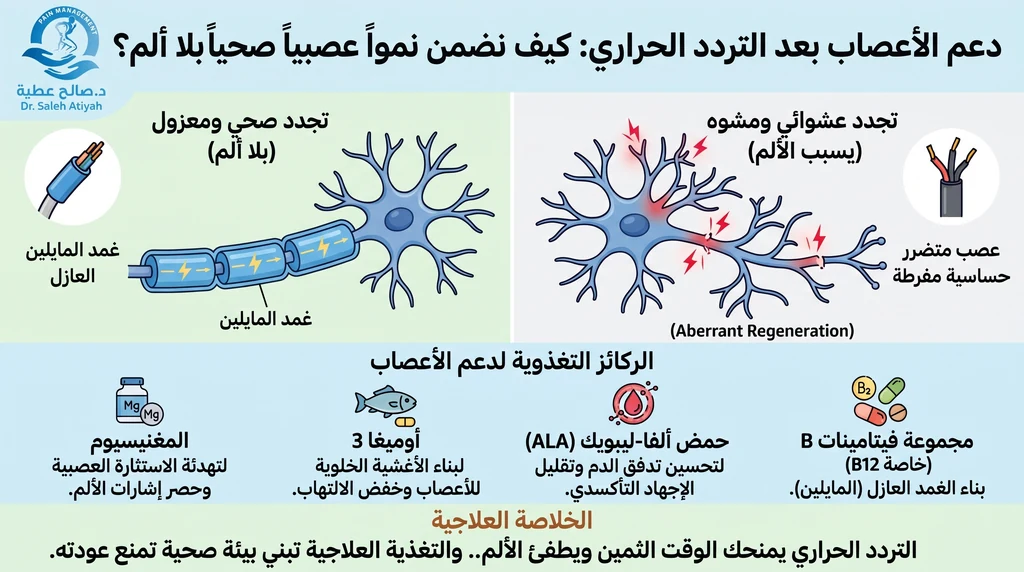
Radiofrequency Ablation is one of the most successful interventional techniques for stopping chronic pain signals arising from irritated joints or vertebrae. This technique works by creating a temporary, programmed disruption in the nerve causing the pain to cut the signal pathway to the brain, giving the patient a valuable window of relief lasting from 6 to 18 months.
However, the body’s cells are genetically programmed to attempt to repair and regenerate damaged peripheral nerves over time (Peripheral Nerve Regeneration). This is where therapeutic nutrition plays its role; not to reverse the effect of the procedure, but to guide the nerve-healing process toward “healthy, insulated healing” instead of “random, distorted, pain-causing regeneration”.
The Medical Paradox: Distorted Regeneration Versus Healthy Regeneration
When a nerve tries to regrow in an environment lacking essential nutrients, the nerve fibers grow randomly and in a tangled manner (Aberrant Regeneration), leaving the nerve exposed and hypersensitive, so it spontaneously fires sharp electrical pain impulses as soon as it grows.
Our role through therapeutic nutrition is to provide the raw materials that ensure the nerve grows surrounded by the myelin sheath (Myelin Sheath), the insulating membrane that protects the nerve and prevents random electrical signals from leaking, just like the plastic material that insulates electrical wires.
Nutritional Pillars for Supporting the Nerves After a Medical Intervention
B Vitamin Group (Especially B12, Cobalamin)
Vitamin B12 is the main driver of the enzymes that build the insulating sheath (myelin) of peripheral nerves. Clinical studies have shown that maintaining excellent B12 levels accelerates the quality of rebuilding the insulating sheath, which prevents the regenerating nerve from transmitting spontaneously triggered chronic pain signals.
Alpha-Lipoic Acid
A very powerful antioxidant that is soluble in both water and fat. Research has demonstrated its strong ability to improve blood flow and microcirculation to the treated nerve fibers, which reduces oxidative stress inside the nerve cell and eases peripheral nerve pain.
Fatty Acids (Omega-3)
The essential fatty acids eicosapentaenoic acid and docosahexaenoic acid, known by the abbreviations EPA and DHA, are directly involved in forming the cell membranes of nerves and support their structural flexibility, in addition to their proven role in lowering the inflammatory cytokines surrounding the nerve roots in the spine.
Magnesium
It acts as a natural blocker of NMDA receptors in the nervous system, the receptors responsible for amplifying and transmitting chronic pain signals. Magnesium helps calm the excessive nerve excitability surrounding the radiofrequency site.
Therapeutic Conclusion
Radiofrequency ablation gives you “precious time” and puts out the fire, and targeted therapeutic nutrition repairs the cellular and tissue environment surrounding the nerve during this time. When the nerve grows back months later, it finds a healthy environment, strong muscles and recovered tissues, which ensures that the original pain does not return or that its intensity is reduced radically and sustainably.
Scientific References
- Nerve Regeneration & B Vitamins: Altun, I., & Kurutaş, E. B. (2016). Vitamin B complex as a rescue therapy for peripheral nerve injury. Journal of Orthopaedic Surgery and Research, 11(1).
- Myelin Sheath Repair: Stabler, S. P. (2013). Clinical practice. Vitamin B12 deficiency. The New England Journal of Medicine, 368(2).
- Alpha-Lipoic Acid in Neuropathy: Mijnhout, G. S., et al. (2012). Alpha lipoic acid for symptomatic peripheral neuropathy. International Journal of Endocrinology, 2012.
- Omega-3 & Neuroprotection: Gladman, S. J., et al. (2007). Improved dietary intake of omega-3 polyunsaturated fatty acids robustly protects axons from injury. Journal of Neuroscience, 27(6).