The Complete Guide to Understanding Peptides and the Body’s Collagen
This guide brings together everything you need to know about peptides and collagen, from the basic concepts to practical use, to be your simple, go-to reference.
1. What Are Peptides (Collagen Peptides)? (The Basic Concept)
Peptides are very short chains of amino acids (the building blocks of protein).
The difference between peptides and protein: a peptide is made up of a small number of units (fewer than 50 amino acids), whereas a protein (such as meat or raw collagen) is a giant, complex chain exceeding 50 amino acids.
Their function: they act as “chemical messages” or signalling molecules that give cells specific instructions to repair tissues, build muscle, or stimulate natural collagen production.
2. Collagen Peptides and Whole Collagen: What Is the Difference?
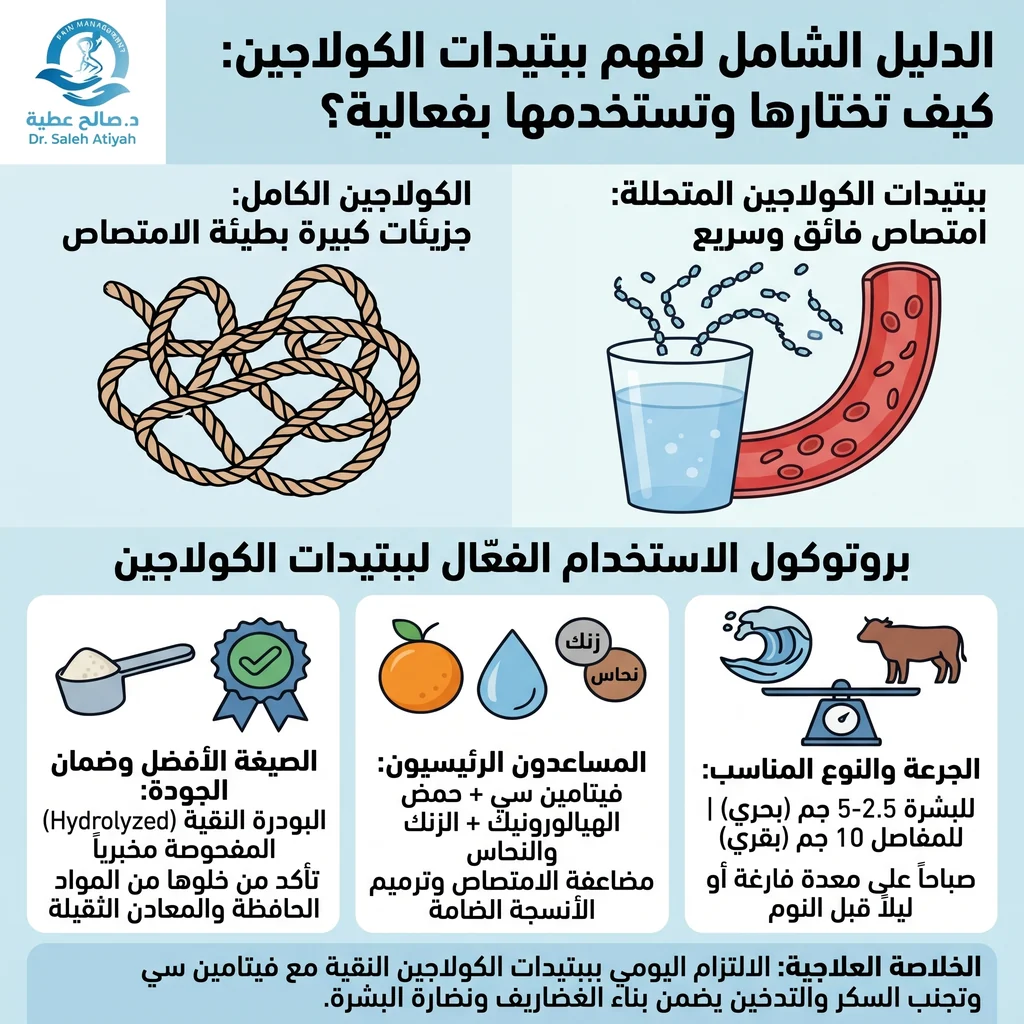
Collagen in its natural (whole) form consists of giant molecules resembling “a very long, thick rope” that the intestine finds difficult to absorb as a single mass.
Collagen peptides (hydrolyzed): this is the same rope after it has been cut in advance into small, pre-cut collagen molecules, ready for immediate absorption without digestive effort. They dissolve instantly in any liquid (cold or hot), and they break down into amino acids and small peptides that are easily absorbed; studies have shown collagen-derived peptides appearing in the blood after hydrolyzed collagen is taken. Some peptides may also act as biological signals that stimulate cells toward processes linked to producing connective-tissue components.
Natural whole collagen: this is collagen in its original raw form with long, complex chains, found in fish skin, chicken wings and tendons. When bones are cooked for long periods, it partially breaks down and turns into gelatin (like bone broth that sets in the refrigerator). This type has large molecules; its absorption is slow and difficult, and part of it is excreted as waste.
3. Settling the Debate: “If It’s All the Same in the End… Why Not Just Use Whole Collagen?”
Chemically speaking, yes, all types of collagen are ultimately broken down in the stomach into amino acids. But the real-world result is completely different because of the following differences:
| Comparison point | Whole collagen (gelatin / foods) | Collagen peptides (hydrolyzed supplements) |
|---|---|---|
| Molecule size | Giant, long and complex chains. | Very small and pre-broken-down. |
| Speed and rate of absorption | Difficult and slow; a large part is excreted as waste without being absorbed. | Readily absorbed; broken down into amino acids and small, easily absorbed peptides; collagen-derived peptides may appear in the blood after hydrolyzed collagen is taken. |
| The “chemical trick” effect | Acts merely as food that supplies the body with ordinary building blocks. | Some peptides may act as biological signals that stimulate cells toward processes linked to producing connective-tissue components. |
| Dissolving and use | Dissolves only in hot liquids, and turns into a jelly-like mass that is hard to swallow when cooled. | Dissolves instantly in any liquid (cold or hot) without changing its texture or taste. |
Summary:
If you are looking for slow, general nutrition, foods and bone broth (whole collagen) are an excellent natural choice. But if you are looking for targeted treatment, fast stimulation of skin radiance, and support for joint flexibility, collagen peptides are the more effective and practical choice.
4. Usage Guide: Dose, Timing and the Right Type
Recommended daily dose by goal:
- Skin radiance and reducing wrinkles: 2.5 to 5 grams daily.
- Hair strength and nail health: about 5 grams daily.
- Joint pain and sports recovery: 10 to 15 grams daily.
Best time to take it:
- In the morning on an empty stomach: to ensure the fastest absorption without competition from the proteins in other foods.
- At night before bed: to align with the body’s natural cycle of recovery and cell building during sleep.
(Daily consistency matters far more than the choice of timing.)
Choosing the most suitable source:
- Marine collagen (from fish – Marine Collagen): rich in type I (Type I), and the best for cosmetic purposes — skin, wrinkles and hair — because of its small molecule size.
- Bovine collagen (Bovine Collagen): rich in types I and III (Type I & III), and the best for health and mobility — joints, cartilage and ligaments.
5. The Key Helpers (Boosting Absorption)
The body cannot build collagen efficiently on its own; it needs supporting nutrients:
- Vitamin C - the essential helper: the main catalyst for linking amino acids and producing collagen. (Take the supplement with orange or lemon juice.)
- Hyaluronic Acid: traps moisture inside skin and joint cells to give a doubled effect on flexibility.
- Zinc and copper: trace minerals that help enzymes repair connective tissues.
6. Timeline for Results to Appear
- Skin smoothness and hydration: after 4 to 6 weeks.
- Skin elasticity and reduced wrinkles: after 8 to 12 weeks (2 to 3 months).
- Relief of joint pain: after 3 to 6 months (because blood flow to cartilage is slower).
7. Protecting Results and the “Maintenance Dose”
Taking collagen without protecting it is like pouring water into a leaking bucket. To protect collagen from destruction:
Avoid the thieves: there are factors that destroy collagen in the body much faster than supplements can replace it. They are:
- Refined sugar and sugars: sugar binds to proteins in the body (including collagen) in a chemical process called glycation (Glycation), producing molecules that stiffen and break down collagen, which accelerates the appearance of wrinkles and sagging skin.
- Excessive sun exposure without protection: ultraviolet rays (UV) penetrate the deep layers of the skin and destroy collagen and elastin fibers very rapidly.
- Smoking: nicotine narrows the blood vessels in the outer layers of the skin, reducing the flow of oxygen and nutrients (and amino acids) that collagen needs to renew itself.
- Chronic stress and lack of sleep: stress releases the hormone “cortisol”, a catabolic hormone that breaks down collagen and connective tissues in the body.
Strengthen your protection: use sunscreen daily, sleep well, and eat foods rich in antioxidants (such as cranberries/blueberries, strawberries, leafy greens and green tea).
Maintenance plans to follow after reaching your goal:
- Reducing the dose: lowering your dose to 2.5 - 5 grams daily for maintenance.
- Intermittent dosing: taking the full dose on only 3 to 4 days a week.
- Cycling: using collagen for 3 months, then stopping completely for one month (a break for the body), then resuming.
8. The Best Supplement Form (Powder, Pills, or Liquid)?
Collagen peptides are available on the market in three main forms (powder, liquid and pills). The best form, scientifically and practically, is powder (Powder), followed by liquid collagen, while pills come last.
Here is a direct comparison explaining the reasons and the pros and cons of each form:
1. Collagen Powder (Powder) - The Best Choice
Why is it the best? It gives you a high concentration of collagen per serving at the best value for money, and it dissolves and is absorbed very quickly.
Advantages: you can easily get a suitable serving of collagen in a single scoop.
It is free of preservatives and can be mixed with coffee, juice or water without changing the texture.
Disadvantages: some unflavored types may have a slightly earthy taste (which can be masked by mixing it with juice or coffee).
2. Liquid Collagen (Liquid) - The Fastest and the Worst Value
Advantages: it comes in ampoules or ready-to-drink bottles, is quickly absorbed because the molecules are already dissolved, and often has pleasant flavors with added vitamin C.
Disadvantages: it is expensive compared with powder and does not last long. It often contains sugars, preservatives and artificial sweeteners to improve the taste, and it is hard to carry while traveling because of the size of the bottles.
3. Collagen Pills or Capsules (Pills) - The Least Efficient
Advantages: easy to carry and swallow, with no taste or smell, and excellent for use while traveling.
Disadvantages: the content per pill is limited compared with powder. This means that getting a large amount of collagen may require taking several pills a day, which can be impractical and costly.
Shopping summary:
- Buy “powder” if you are looking for real results and excellent value for money for daily use.
- Buy “liquid” if your budget allows and you are looking for maximum convenience and ready flavor.
- Buy “pills” only for temporary travel and light use.
When buying a collagen supplement (especially the powder form), do not be fooled by catchy marketing phrases on the front. The whole secret lies in reading the back of the package (the nutrition label and certifications).
Here are the most important phrases and certifications that assure you the product is pure, genuine and effective:
1. Phrases Confirming Collagen Quality and Manufacturing (Ingredients)
These words:
- Hydrolyzed Collagen Peptides: mandatory; this means the collagen is broken down and cut to ensure superior absorption. If only “Collagen” is written without the word “Hydrolyzed” or “Peptides”, it is most likely whole, solid collagen that is hard to absorb.
- Grass-Fed & Pasture-Raised: means the cattle were raised on natural pastures and fed on grass (bovine collagen). These terms describe how the animal was fed or raised; on their own they do not mean hormones or antibiotics were not used unless a separate certification or statement confirms this.
- Wild-Caught: (if it is marine collagen) means the fish were caught in open oceans and seas, and are not farmed fish fed on chemicals.
2. Third-Party Certifications and Testing (Product Purity and Freedom from Heavy Metals)
Excellent companies test their products in independent laboratories to make sure the powder is free of lead, mercury and toxic heavy metals that can accumulate in animal bones and skin.
Look for these logos or phrases on the package:
- Third-Party Tested: confirmation that the product has been checked by an independent laboratory.
- USP Verified or NSF Certified: these certifications or third-party tests provide an additional level of independent verification that the contents match the label and meet limits for certain contaminants, according to the scope of each program.
- Non-GMO Verified: a certification proving that the product has been tested and is completely free of genetically modified ingredients.
3. A Smart Tip for Reading the Ingredients Label (Ingredients List)
Read the ingredients line (written in small print below the nutrition facts table):
The ideal product: should contain only one ingredient, (Hydrolyzed Bovine/Marine Collagen Peptides, or with only Hyaluronic Acid / Vitamin C added).
Avoid the product if: you see a long list of chemical names, added sugars, artificial flavors, and fillers (Fillers), because they reduce the concentration of the actual collagen you are paying for.
How to calculate the net amount of collagen in one scoop of powder to make sure it covers your daily dose:
Calculating the net amount of collagen in one scoop is a very simple process, done by checking the Supplement Facts table on the back of the package.
Here are the three steps to do it like a professional:
1. Look at the “Serving Size”
At the very top of the table, look for the phrase Serving Size.
You will find it written, for example, as: Serving Size: 1 Scoop (11g). This means the weight of one scoop, as whole powder, is 11 grams.
2. Look at the Net Amount of Collagen (Collagen Peptides)
Move your eyes down the table to the ingredients list and look for the line Hydrolyzed Collagen Peptides. Look at the number written next to it in the weight column.
In different products, you will find a value written next to it that expresses the weight of the peptides in the serving.
3. Compare the Two Numbers (The Purity Equation)
Now compare the total weight of the scoop with the net weight of the collagen:
If the serving size and the amount of collagen are very close, this is a high-purity product, because the small difference may be due to added extra ingredients.
But if the serving size is large and the net amount of collagen is small, this means the product contains additives, flavors and other ingredients.
Comparing package contents while shopping:
When reading product labels to compare:
- You may find one package that provides a certain amount of collagen per serving.
- And you may find another package that provides a different amount, which requires reading the label carefully to understand the overall concentration.
Scientific References & Studies
Oesser, S., Adam, M., Babel, W., & Seifert, J. (1999). Oral administration of (14)C labeled gelatin hydrolysate leads to an accumulation of radioactivity in cartilage of mice (C57/BL). The Journal of Nutrition, 129(10), 1891–1895.
Study type: Animal study (mice)
What this study supports: Animal study in mice using radiolabeled gelatin hydrolysate; supports gastrointestinal absorption and distribution of gelatin-hydrolysate-derived material, including accumulation in cartilage, in mice. It does not prove complete absorption in humans.Oesser, S., & Seifert, J. (2003). Stimulation of type II collagen biosynthesis and secretion in bovine chondrocytes cultured with degraded collagen. Cell and Tissue Research, 311(3), 393–399.
DOI: 10.1007/s00441-003-0702-8
Study type: In-vitro study (bovine chondrocytes)
What this study supports: In-vitro study in bovine chondrocytes; supports stimulation of type II collagen biosynthesis and secretion by degraded collagen in this cell model. It is not direct clinical proof in humans.Clark, K. L., Sebastianelli, W., Flechsenhar, K. R., Aukermann, D. F., Meza, F., Millard, R. L., Deitch, J. R., Sherbondy, P. S., & Albert, A. (2008). 24-Week study on the use of collagen hydrolysate as a dietary supplement in athletes with activity-related joint pain. Current Medical Research and Opinion, 24(5), 1485–1496.
Study type: Human randomized controlled study (athletes, 24 weeks)
What this study supports: Human randomized controlled study in athletes with activity-related joint pain; supports improvement in some joint-pain measures after collagen hydrolysate supplementation in this population. It does not demonstrate cartilage regeneration.McAlindon, T. E., Nuite, M., Krishnan, N., Ruthazer, R., Price, L. L., Burstein, D., Griffith, J., & Flechsenhar, K. (2011). Change in knee osteoarthritis cartilage detected by delayed gadolinium enhanced magnetic resonance imaging following treatment with collagen hydrolysate: a pilot randomized controlled trial. Osteoarthritis and Cartilage, 19(4), 399–405.
DOI: 10.1016/j.joca.2011.01.001
Study type: Pilot randomized controlled trial
What this study supports: Small pilot randomized controlled trial in knee osteoarthritis; detected significant dGEMRIC changes in some cartilage regions at 24 weeks, but no significant between-group differences in the reported clinical outcomes or T2 measurements.Shaw, G., Lee-Barthel, A., Ross, M. L., Wang, B., & Baar, K. (2017). Vitamin C–enriched gelatin supplementation before intermittent activity augments collagen synthesis. The American Journal of Clinical Nutrition, 105(1), 136–143.
Study type: Randomized crossover human study (8 healthy men)
What this study supports: Small randomized crossover study in 8 healthy men; vitamin C–enriched gelatin, particularly 15 g before exercise, increased circulating amino acids and a blood marker of collagen synthesis. It is not direct proof of joint or ligament repair.García-Coronado, J. M., Martínez-Olvera, L., Elizondo-Omaña, R. E., Acosta-Olivo, C. A., Vilchez-Cavazos, F., Simental-Mendía, L. E., & Simental-Mendía, M. (2019). Effect of collagen supplementation on osteoarthritis symptoms: a meta-analysis of randomized placebo-controlled trials. International Orthopaedics, 43(3), 531–538.
DOI: 10.1007/s00264-018-4211-5
Study type: Meta-analysis of randomized placebo-controlled trials
What this study supports: The meta-analysis reported improvements in total WOMAC and VAS scores with collagen supplementation, while some individual WOMAC pain and functional subscores were not significantly different.